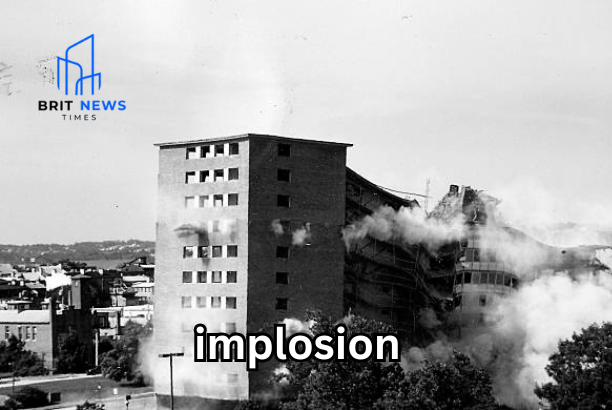
An implosion occurs when an object collapses inward because the external pressure is greater than the pressure inside the object.
Unlike an explosion, which pushes outward, an implosion pulls inward.
A simple way to understand it is this:
- Explosion = pressure moves out
- Implosion = pressure moves in
The process can happen in many environments, including:
- Deep oceans
- Industrial facilities
- Scientific laboratories
- Controlled building demolitions
- Vacuum chambers
When the structure can no longer withstand the pressure difference, it collapses rapidly inward.
How Does an Implosion Happen?
An implosion happens when a structure experiences an overwhelming force from outside.
For example, imagine a sealed container placed deep underwater. As depth increases, water pressure rises dramatically. If the container weakens or develops a structural flaw, the surrounding pressure can crush it inward almost instantly.
The basic stages include:
- Increasing external pressure
- Structural weakness develops
- Critical failure point is reached
- Rapid inward collapse occurs
- Energy is released during compression
This process often happens faster than human reaction time.
The Titan Submersible Implosion Explained
The most widely discussed example in recent years is the Titan submersible implosion.
The Titan vessel was operated by OceanGate and was designed to carry passengers to view the wreck of the Titanic.
During a dive in June 2023, communication with the submersible was lost. Investigations later concluded that the vessel suffered a catastrophic implosion deep underwater.
The OceanGate implosion attracted global attention because of the extreme depth involved.
At nearly 4,000 meters below sea level, water pressure becomes enormous. At those depths, even small structural issues can become critical.
The tragedy led to renewed discussions about:
- Deep-sea safety
- Engineering standards
- Material testing
- Commercial exploration risks
- Emergency preparedness
Why the Titan Implosion Happened So Quickly
One reason the Titan implosion fascinated the public is the speed at which it occurred.
Deep underwater, pressure can exceed hundreds of times the atmospheric pressure experienced at sea level.
When structural failure occurs:
- Water rushes inward instantly
- The vessel collapses
- Compression happens in milliseconds
- The event occurs faster than the human brain can process
This is why experts often describe deep-sea implosions as nearly instantaneous.
Titan Implosion Remains and Recovery Efforts
After the accident, recovery teams located debris from the vessel on the ocean floor.
Discussion surrounding Titan implosion remains focused on understanding the failure mechanism and gathering evidence for investigators.
The recovery operation helped experts:
- Analyze structural components
- Examine failure points
- Improve future safety recommendations
- Better understand deep-sea engineering challenges
The findings continue to influence discussions about commercial submarine tourism.
Submarine Implosion vs Explosion
Many people confuse a submarine implosion with an explosion.
The differences are significant.
Explosion
- Pressure originates inside
- Material moves outward
- Creates a blast wave
- Often associated with fire or combustion
Implosion
- Pressure originates outside
- Material collapses inward
- No outward fireball
- Often caused by crushing forces
Understanding this distinction helps explain why the Titan disaster was categorized as an implosion rather than an explosion.
What Happens During a Submersible Implosion?
A submersible implosion involves several physical forces occurring simultaneously.
When a vessel descends deeper into the ocean:
- Water pressure increases continuously
- Structural stress accumulates
- Weak points become vulnerable
- Sudden failure triggers collapse
Once collapse begins, the surrounding water fills the available space almost instantly.
One unique insight often overlooked is that the deeper a vessel travels, the smaller the margin for structural error becomes. Tiny defects that might be harmless at shallow depths can become catastrophic thousands of meters underwater.
Titan Implosion Simulation and Public Interest
Many educational creators developed a Titan implosion simulation to help the public understand the physics involved.
These simulations typically demonstrate:
- Pressure differences
- Structural collapse
- Deep-ocean conditions
- Material stress responses
While simulations cannot perfectly recreate every detail of a real-world event, they help explain why deep-sea environments are among the most challenging engineering settings on Earth.
Human Implosion: Is It Possible?
The term human implosion is often searched online, but it is frequently misunderstood.
Humans do not implode in the same way that sealed mechanical structures do.
The human body contains fluids and tissues that respond differently to pressure changes than hollow vessels.
In extreme pressure environments, injuries can occur, but the dramatic “imploding person” image often portrayed in fiction is not scientifically accurate.
This misunderstanding became more common after media coverage of the Titan disaster.
Implosion in Building Demolition
Not all implosions are accidents.
Controlled implosions are widely used in construction and demolition.
Professional demolition teams strategically place explosives so a structure collapses inward.
Benefits include:
- Reduced damage to nearby buildings
- Better debris containment
- Faster demolition process
- Improved site safety
This is why many people also search for implosion demolition companies when researching large-scale building removals.
How Controlled Implosions Work
A controlled demolition implosion follows a carefully planned sequence.
Engineers determine:
- Structural load points
- Weakening locations
- Timing of explosive charges
- Desired collapse direction
The goal is to make the structure fall into its own footprint.
This process requires extensive planning and precise execution.
The Science Behind Pressure and Implosion
Pressure plays the central role in every implosion event.
Key factors include:
External Force
Pressure from water, air, or surrounding materials pushes inward.
Structural Integrity
Strong materials resist pressure longer.
Depth
Greater depth means greater pressure.
Material Fatigue
Repeated stress can weaken structures over time.
A second unique insight is that many catastrophic failures begin with microscopic flaws that remain invisible during routine observation. Engineers often spend years developing methods to detect these tiny weaknesses before they become dangerous.
Implosion Documentary Interest After the Titan Disaster
Following the tragedy, interest in the implosion documentary genre increased significantly.
Viewers became interested in:
- Deep-sea exploration
- Engineering failures
- Ocean technology
- Risk management
- Human curiosity about extreme environments
The event transformed a relatively obscure engineering term into a widely discussed scientific topic.
Facts About Implosions
Here are some fascinating facts about implosions:
- Implosions occur because external pressure exceeds internal pressure.
- Deep-sea environments create some of the most powerful implosion risks on Earth.
- Controlled implosions are commonly used in demolition projects.
- Implosions can happen in milliseconds.
- The Titan disaster introduced millions of people to implosion physics.
- Engineers spend years designing systems to prevent implosion failures.
A third unique insight is that public fascination with implosions often comes from the fact that they are largely invisible. Unlike explosions, which create dramatic outward effects, implosions occur inward and are often hidden from direct observation.
Common Misconceptions About Implosions
Implosions Are Just Reverse Explosions
While partly true, implosions involve unique physical processes and engineering challenges.
Only Submarines Implode
Many structures, containers, and industrial systems can experience implosion under the right conditions.
Implosions Always Cause Massive Destruction
Controlled implosions are intentionally designed to minimize damage.
Implosions Take Several Seconds
Many catastrophic implosions happen almost instantaneously.
FAQ
What is an implosion?
An implosion is the inward collapse of an object caused by external pressure exceeding internal pressure. Unlike an explosion, the force moves inward rather than outward.
What happened during the Titan submersible implosion?
The Titan vessel suffered a catastrophic structural failure during a deep-sea dive near the Titanic wreck site. Investigators concluded that overwhelming ocean pressure caused the submersible to implode.
How is a submarine implosion different from an explosion?
A submarine implosion involves crushing pressure from outside the vessel, while an explosion involves force originating from inside and moving outward.
Why do people search for Titan implosion simulation?
Simulations help visualize how extreme underwater pressure affects structures and explain why the collapse occurred so rapidly.
Are controlled implosions used in construction?
Yes. Engineers frequently use controlled implosions to demolish buildings safely by directing structures to collapse inward.
What can we learn from the OceanGate implosion?
The incident highlights the importance of engineering standards, material testing, safety oversight, and understanding the risks of operating in extreme environments.
Conclusion
Understanding the true implosion meaning helps explain one of the most discussed engineering disasters of recent years. From the OceanGate Titan submersible implosion to controlled building demolitions, implosions occur when overwhelming external pressure causes a structure to collapse inward. The tragedy involving Titan brought global attention to deep-sea engineering and reminded the world of the extraordinary forces present beneath the ocean. By learning how implosions work, readers gain a better appreciation for both the science of pressure and the challenges faced by engineers operating in extreme environments.